Yankee Stadium Soccer Field Discourse Ignited During Liverpool vs Wrexham

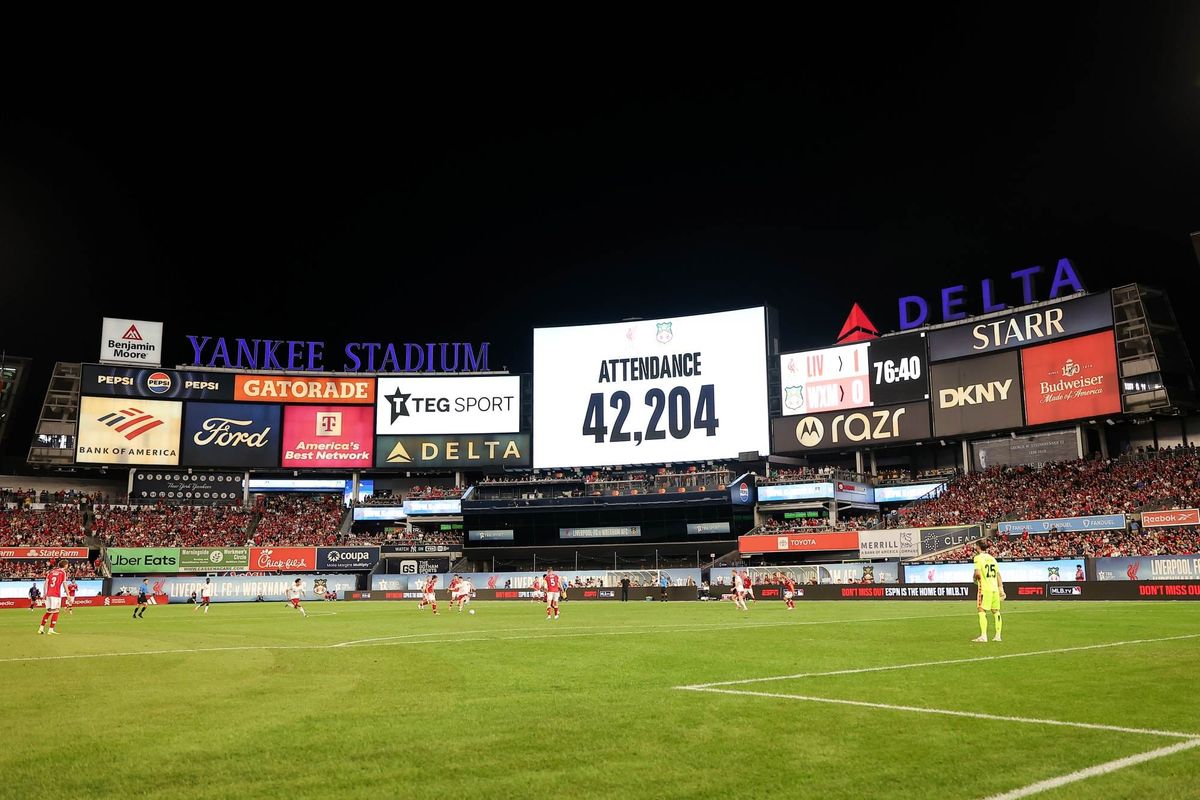
Yankee Stadium hosted a pre-season friendly between Liverpool FC and Wrexham AFC on Wednesday night, attracting the second-largest soccer crowd of the year to the venue, and igniting the soccer-on-a-baseball-field discourse among a wider audience.
A crowd of 42,204 turned out in The Bronx to watch the game, a number only beaten in 2026 by the match between New York City and Inter Miami (45,845) on March 22.
The extra eyeballs on soccer at the home of the New York Yankees, both at the stadium and around the world on TV, led to the latest round of discussion on the venue's use for soccer.
The Yankee Stadium team store — which has Wrexham and Liverpool merch on sale tonight — is absolutely packed. pic.twitter.com/Dvj5n7lEdK
— Matthew Mangam (@MatthewMangam) July 29, 2026
The field at Yankee Stadium has been an endless subject of debate since Major League Soccer team New York City FC moved in as tenants in their debut season in 2015.
This usually focuses on the size of the pitch, in that many think it’s too small, and on the playing surface where the temporary grass covers the parts of the baseball diamond that protrude onto the soccer field. Other issues raised include sight lines and the position of the stands relative to the field.
It feels like such topics are raised pretty much every time a game of soccer is played there. Given NYCFC is in its 12th season with Yankee Stadium as its primary home, this is a lot of games, and a lot of repetition of the same points.
The franchise has repeatedly moved to confirm that the field is at or above the minimum dimensions required by MLS and across the game as a whole
For context, its stated dimensions of 110 yards by 70 yards (101m by 64m) are only slightly narrower and slightly longer than those at the home of English Premier League club Fulham, Craven Cottage, which comes in at 100m by 65m.
In an MLS context, the soccer field dimensions at Yankee Stadium are supposedly exactly the same as San Diego FC’s Snapdragon Stadium.
The aforementioned issues of sightlines and seating locations, some of which are quite far from the field, can make the Yankee Stadium pitch appear even smaller than it actually is. Baseball stadiums are built for the arc of a baseball field rather than the rectangle of a soccer pitch, so they can feel disconcerting at first if you're not used to watching soccer at one.
Despite that, they have long served as homes for soccer teams and soccer games.
In the early days of soccer in England, sports clubs would play cricket in the summer and soccer in the winter, often on the same or adjacent fields because it was practical to do so.
Similarly, especially in a crowded urban footprint like that of New York City, existing baseball fields have proven practical for soccer.
Cutting a long story short, the sport of baseball developed in an organised fashion in America throughout the 19th and 20th centuries in the way soccer did in many other countries. Soccer did begin to grow in the US at a similar time, but, again, to cut a long story short, there was a lack of organization that prevented it from growing organically as it did elsewhere.
This is one of the reasons baseball fields still dominate the landscape (literally) of America's sporting towns and cities. They staked their place ahead of or alongside other uses of land and real estate, even in areas, such as NYC, where there is now little or no space left for anything else. And even where there is space, there are political and financial obstacles to overcome, as NYCFC and others have learnt.
This is one of the reasons soccer teams, and indeed other sports teams, can struggle to find suitable homes in New York City, and why they often move out to the slightly larger expanses of available land across the Hudson River in New Jersey.
With this in mind, it makes perfect sense for soccer teams based in New York to play on baseball fields, as New York City FC has done at Yankee Stadium and Citi Field, and new USL Championship franchise Brooklyn FC also does at Maimonides Park on Coney Island.
There is a famous clip of Pele playing for the New York Cosmos at the original Yankee Stadium where the baseball diamond and infield dirt/sand have not even been covered with temporary grass.
As the Liverpool v Wrexham game sparked the latest round of Yankee Stadium as a soccer field discourse, here's Pele playing at the stadium for New York Cosmos when they didn't even cover the infield dirt/sand with temporary grass.
— The Soccer Times (@nysoccertimes.com) 30 July 2026 at 15:00
[image or embed]
One iteration of the Cosmos also played a season at Maimonides Park in 2017, and the latest version plays at the historic Hinchliffe baseball stadium in Paterson, New Jersey.
Though quite narrow themselves when the rectangle of the soccer field has been drawn, baseball stadiums are often preferable to American football fields, which can be even narrower.
It is common, though, to see lower-league or semi-pro and amateur teams playing on artificial turf fields which have football and other markings. Again, this makes sense for practicality and for creating community spaces where multiple teams and multiple sports can be played.
Opposition teams regularly use the baseball stadium theme to mock New York City FC on social media before games, such is the unprofessional nature of even official output on those channels these days. This often backfires, however, and NYCFC’s own Admin has taken delight in pushing back against these on the occasions it is victorious.
Another baseball tweet, another L https://t.co/t7hGLVhiUq pic.twitter.com/zMZfxpovqg
— New York City FC (@newyorkcityfc) July 26, 2026
New York City FC will not have to contend with baseball fields for much longer, though, as it moves into a new, soccer-specific home at Willets Point, Queens, in time for MLS’s switch to a fall/spring schedule in 2027/28. It will be joined there by NWSL team Gotham FC from 2028.
Even an ownership with apparently endless funds, like City Football Group, has struggled to make this happen in the franchise’s first decade of existence, but it eventually found a solution in the Iron Triangle where the new stadium is being built across the road from Citi Field. Or, as F. Scott Fitzgerald called it in The Great Gatsby, the Valley of Ashes, a name that some fans have already taken to calling it.
NYCFC will be glad to get a stadium to call their own, while opposition teams and fans may be disappointed to no longer be able to make baseball-field jibes, but the truth is that baseball parks have played a big part in the history of soccer in the United States, and continue to do so. They should not be mocked so readily.